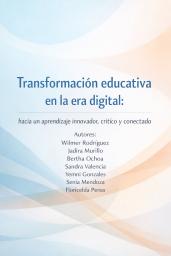
Transformación educativa en la era digital: hacia un aprendizaje innovador, crítico y conectado
Synopsis
El presente libro ofrece un análisis integral de la transformación educativa en la era digital, con especial atención al sistema educativo ecuatoriano en sus niveles de Educación Inicial, Preparatoria, Educación General Básica (Elemental, Media y Superior) y Bachillerato General Unificado. A partir de marcos teóricos como el conectivismo, el constructivismo digital y la pedagogía crítica, se examina cómo las tecnologías de la información y la comunicación (TIC) pueden integrarse de manera significativa en los procesos de enseñanza y aprendizaje.
La obra aborda temáticas fundamentales como el juego digital en la primera infancia, la alfabetización emergente mediada por tecnología, las metodologías activas en la educación básica, el pensamiento computacional, la ciudadanía digital, la inteligencia artificial en el bachillerato y la formación docente como eje articulador del cambio. Se sustenta en investigaciones empíricas recientes publicadas en revistas indexadas, tanto en español como en inglés, y dialoga con la normativa ecuatoriana vigente, particularmente la Ley Orgánica de Educación Intercultural (LOEI), el Currículo Nacional y los estándares de calidad educativa. El propósito central es contribuir al debate académico sobre cómo construir un modelo educativo innovador, crítico y conectado que responda a las demandas del siglo XXI sin perder de vista los principios de equidad, interculturalidad e inclusión que caracterizan el proyecto educativo del Ecuador.
Downloads
References
Area Moreira, M. y Pessoa, T. (2012). De lo sólido a lo líquido: las nuevas alfabetizaciones ante los cambios culturales de la Web 2.0. Comunicar, 19(38), 13–20. https://doi.org/10.3916/C38-2012-02-01
Asamblea Nacional del Ecuador. (2021). Ley Orgánica Reformatoria a la Ley Orgánica de Educación Intercultural. Registro Oficial, Suplemento 434.
Barr, V. y Stephenson, C. (2011). Bringing computational thinking to K–12: What is involved and what is the role of the computer science education community? ACM Inroads, 2(1), 48–54. https://doi.org/10.1145/1929887.1929905
Bell, T., Alexander, J., Freeman, I. y Grimley, M. (2009). Computer science unplugged: School students doing real computing without computers. The New Zealand Journal of Applied Computing and Information Technology, 13(1), 20–29. https://doi.org/10.3316/informit.455255199702470
Benitti, F. B. V. (2012). Exploring the educational potential of robotics in schools: A systematic review. Computers & Education, 58(3), 978–988. https://doi.org/10.1016/j.compedu.2011.10.006
Bergmann, J. y Sams, A. (2012). Flip your classroom: Reach every student in every class every day. ISTE/ASCD.
Beschorner, B. y Hutchison, A. (2013). iPads as a literacy teaching tool in early childhood. International Journal of Education in Mathematics, Science and Technology, 1(1), 16–24. https://doi.org/10.18404/ijemst.07897
Binkley, M., Erstad, O., Herman, J., Raizen, S., Ripley, M., Miller Ricci, M. y Rumble, M. (2012). Defining twenty‐first century skills. En P. Griffin, B. McGaw y E. Care (Eds.), Assessment and teaching of 21st century skills (pp. 17–66). Springer. https://doi.org/10.1007/978-94-007-2324-5_2
Black, P. y Wiliam, D. (2009). Developing the theory of formative assessment. Educational Assessment, Evaluation and Accountability, 21(1), 5–31. https://doi.org/10.1007/s11092-008-9068-5
Boss, S. y Krauss, J. (2014). Reinventing project‐based learning: Your field guide to real‐world projects in the digital age (2.ª ed.). ISTE.
Bravo Valdivieso, L. (2016). El aprendizaje del lenguaje escrito y las ciencias de la lectura. Un límite entre la psicología cognitiva, las neurociencias y la educación. Límite: Revista Interdisciplinaria de Filosofía y Psicología, 11(36), 50–59. https://doi.org/10.4067/S0718-50652016000100005
Brennan, K. y Resnick, M. (2012). New frameworks for studying and assessing the development of computational thinking. Proceedings of the 2012 Annual Meeting of the American Educational Research Association, 1–25.
Cabero‐Almenara, J. y Palacios‐Rodríguez, A. (2020). Marco Europeo de Competencia Digital Docente «DigCompEdu» y cuestionario «DigCompEdu Check‐In». EDMETIC, Revista de Educación Mediática y TIC, 9(1), 213–234. https://doi.org/10.21071/edmetic.v9i1.12462
Cast. (2018). Universal Design for Learning Guidelines version 2.2. https://doi.org/10.3109/17518423.2013.860614
Castañeda, L. y Selwyn, N. (2018). More than tools? Making sense of the ongoing digitizations of higher education. International Journal of Educational Technology in Higher Education, 15(1), 22. https://doi.org/10.1186/s41239-018-0109-y
Cobo, C. y Moravec, J. W. (2011). Aprendizaje invisible: hacia una nueva ecología de la educación. Edicions de la Universitat de Barcelona. https://doi.org/10.1344/106.000002160
Corbett, C. y Hill, C. (2015). Solving the equation: The variables for women's success in engineering and computing. AAUW.
Domínguez Castillo, J. G., Cisneros‐Cohernour, E. J., Suaste Escalante, M. A. y Vázquez‐Chagoyán, R. (2021). STEAM education and educational innovation in Mexico. Revista Electrónica de Investigación Educativa, 23, e17. https://doi.org/10.24320/redie.2021.23.e17.3735
Ertmer, P. A. y Ottenbreit‐Leftwich, A. (2013). Removing obstacles to the pedagogical changes required by Jonassen's vision of authentic technology‐enabled learning. Computers & Education, 64, 175–182. https://doi.org/10.1016/j.compedu.2012.10.008
Falloon, G. (2013). Young students using iPads: App design and content influences on their learning pathways. Computers & Education, 68, 505–521. https://doi.org/10.1016/j.compedu.2013.06.006
Fleer, M. (2017). Digital role‐play: The changing conditions of children's play in preschool settings. Mind, Culture, and Activity, 24(1), 3–17. https://doi.org/10.1080/10749039.2016.1247456
Floridi, L., Cowls, J., Beltrametti, M., Chatila, R., Chazerand, P., Dignum, V. y Vayena, E. (2018). AI4People: An ethical framework for a good AI society. Minds and Machines, 28(4), 689–707. https://doi.org/10.1007/s11023-018-9482-5
Freeman, S., Eddy, S. L., McDonough, M., Smith, M. K., Okoroafor, N., Jordt, H. y Wenderoth, M. P. (2014). Active learning increases student performance in science, engineering, and mathematics. Proceedings of the National Academy of Sciences, 111(23), 8410–8415. https://doi.org/10.1073/pnas.1319030111
Fullan, M. (2013). Stratosphere: Integrating technology, pedagogy, and change knowledge. Pearson.
García‐Peñalvo, F. J. (2017). Mapa de tendencias en innovación educativa. Education in the Knowledge Society, 18(4), 7–23. https://doi.org/10.14201/eks2017184723
Giroux, H. A. (2011). On critical pedagogy. Continuum. https://doi.org/10.5040/9781350190078
Grover, S. y Pea, R. (2013). Computational thinking in K–12: A review of the state of the field. Educational Researcher, 42(1), 38–43. https://doi.org/10.3102/0013189X12463051
Haboud, M. (2019). Language revitalization in the Andes: Can the Kichwa survive? En L. Hinton, L. Huss y G. Roche (Eds.), The Routledge handbook of language revitalization (pp. 219–228). Routledge. https://doi.org/10.4324/9781315561271-27
Halverson, E. R. y Sheridan, K. (2014). The maker movement in education. Harvard Educational Review, 84(4), 495–504. https://doi.org/10.17763/haer.84.4.34j1g68140382063
Hamari, J., Koivisto, J. y Sarsa, H. (2014). Does gamification work? A literature review of empirical studies on gamification. 2014 47th Hawaii International Conference on System Sciences, 3025–3034. https://doi.org/10.1109/HICSS.2014.377
Healey, M., Jenkins, A. y Lea, J. (2014). Developing research‐based curricula in college‐based higher education. The Higher Education Academy.
Hirsh‐Pasek, K., Zosh, J. M., Golinkoff, R. M., Gray, J. H., Robb, M. B. y Kaufman, J. (2015). Putting education in «educational» apps: Lessons from the science of learning. Psychological Science in the Public Interest, 16(1), 3–34. https://doi.org/10.1177/1529100615569721
Holmes, W., Bialik, M. y Fadel, C. (2019). Artificial intelligence in education: Promises and implications for teaching and learning. Center for Curriculum Redesign.
Howard‐Jones, P. (2014). Neuroscience and education: A review of educational interventions and approaches informed by neuroscience. Education Endowment Foundation.
Johnson, D. W. y Johnson, R. T. (2019). Cooperative learning: The foundation for active learning. En S. M. Brito (Ed.), Active learning: Beyond the future (pp. 59–71). IntechOpen. https://doi.org/10.5772/intechopen.81086
Jonassen, D. H. (1999). Designing constructivist learning environments. En C. M. Reigeluth (Ed.), Instructional‐design theories and models: A new paradigm of instructional theory (vol. 2, pp. 215–239). Lawrence Erlbaum Associates.
Jones, L. M. y Mitchell, K. J. (2016). Defining and measuring youth digital citizenship. New Media & Society, 18(9), 2063–2079. https://doi.org/10.1177/1461444815577797
Kafai, Y. B. y Burke, Q. (2014). Connected code: Why children need to learn programming. MIT Press. https://doi.org/10.7551/mitpress/9992.001.0001
Kasneci, E., Sessler, K., Küchemann, S., Bannert, M., Dementieva, D., Fischer, F., Gasser, U., Groh, G., Günnemann, S., Hüllermeier, E., Kruber, S., Kutyniok, G., Michaeli, T., Nerdel, C., Pfeffer, J., Poquet, O., Sailer, M., Schmidt, A., Seidel, T., ... Kasneci, G. (2023). ChatGPT for good? On opportunities and challenges of large language models for education. Learning and Individual Differences, 103, 102274. https://doi.org/10.1016/j.lindif.2023.102274
Kokotsaki, D., Menzies, V. y Wiggins, A. (2016). Project‐based learning: A review of the literature. Improving Schools, 19(3), 267–277. https://doi.org/10.1177/1365480216659733
Krajcik, J. S. y Shin, N. (2014). Project‐based learning. En R. K. Sawyer (Ed.), The Cambridge handbook of the learning sciences (2.ª ed., pp. 275–297). Cambridge University Press. https://doi.org/10.1017/CBO9781139519526.018
Larmer, J., Mergendoller, J. y Boss, S. (2015). Setting the standard for project‐based learning: A proven approach to rigorous classroom instruction. ASCD.
Leithwood, K. y Louis, K. S. (2011). Linking leadership to student learning. Jossey‐Bass.
Long, D. y Magerko, B. (2020). What is AI literacy? Competencies and design considerations. Proceedings of the 2020 CHI Conference on Human Factors in Computing Systems, 1–16. https://doi.org/10.1145/3313831.3376727
Luckin, R., Holmes, W., Griffiths, M. y Forcier, L. B. (2016). Intelligence unleashed: An argument for AI as a tool for teachers. Pearson Education.
Lugo, M. T. e Ithurburu, V. (2019). Políticas digitales en América Latina: tecnologías para fortalecer la educación de calidad. Revista Iberoamericana de Educación, 79(1), 11–31. https://doi.org/10.35362/rie7913398
Mato, D. (2018). Educación superior y pueblos indígenas y afrodescendientes en América Latina: tendencias en curso, tensiones, posibilidades y desafíos. En P. Henríquez Guajardo (Ed.), Tendencias de la educación superior en América Latina y el Caribe 2018 (pp. 59–74). UNESCO‐IESALC.
Ministerio de Educación del Ecuador. (2014). Currículo de Educación Inicial. Ministerio de Educación.
Ministerio de Educación del Ecuador. (2016). Currículo de los niveles de educación obligatoria. Ministerio de Educación.
Ministerio de Educación del Ecuador. (2017). Estándares de Calidad Educativa: aprendizaje, gestión escolar, desempeño profesional e infraestructura. Ministerio de Educación.
Mishra, P. y Koehler, M. J. (2006). Technological pedagogical content knowledge: A framework for teacher knowledge. Teachers College Record, 108(6), 1017–1054. https://doi.org/10.1111/j.1467-9620.2006.00684.x
Miyahira Arakaki, J. M. (2009). La investigación formativa y la formación para la investigación en el pregrado. Revista Médica Herediana, 20(3), 119–122. https://doi.org/10.20453/rmh.v20i3.1010
Niklas, F. y Schneider, W. (2013). Home literacy environment and the beginning of reading and spelling. Contemporary Educational Psychology, 38(1), 40–50. https://doi.org/10.1016/j.cedpsych.2012.10.001
Ortega‐Ruiz, R., Del Rey, R. y Casas, J. A. (2012). Knowing, building and living together on internet and social networks: The ConRed program. International Journal of Conflict and Violence, 6(2), 302–312. https://doi.org/10.4119/ijcv-2929
Papert, S. (1980). Mindstorms: Children, computers, and powerful ideas. Basic Books.
Plowman, L. y McPake, J. (2013). Seven myths about young children and technology. Childhood Education, 89(1), 27–33. https://doi.org/10.1080/00094056.2013.757490
Prensky, M. (2001). Digital natives, digital immigrants Part 1. On the Horizon, 9(5), 1–6. https://doi.org/10.1108/10748120110424816
Puentedura, R. R. (2014). SAMR and TPCK: A hands‐on approach to classroom practice. http://www.hippasus.com/rrpweblog/
Radesky, J. S. y Christakis, D. A. (2016). Increased screen time: Implications for early childhood development and behavior. Pediatric Clinics of North America, 63(5), 827–839. https://doi.org/10.1016/j.pcl.2016.06.006
Reimers, F. y Schleicher, A. (2020). A framework to guide an education response to the COVID‐19 pandemic of 2020. OECD.
Resnick, M., Maloney, J., Monroy‐Hernández, A., Rusk, N., Eastmond, E., Brennan, K., Millner, A., Rosenbaum, E., Silver, J., Silverman, B. y Kafai, Y. (2009). Scratch: Programming for all. Communications of the ACM, 52(11), 60–67. https://doi.org/10.1145/1592761.1592779
Ribble, M. (2015). Digital citizenship in schools (3.ª ed.). ISTE.
Rinaldi, C. (2006). In dialogue with Reggio Emilia: Listening, researching and learning. Routledge. https://doi.org/10.4324/9780203317730
Selwyn, N. (2016). Education and technology: Key issues and debates (2.ª ed.). Bloomsbury Academic.
Selwyn, N. (2019). Should robots replace teachers? AI and the future of education. Polity Press.
Siemens, G. (2005). Connectivism: A learning theory for the digital age. International Journal of Instructional Technology and Distance Learning, 2(1), 3–10.
Stommel, J., Friend, C. y Morris, S. M. (Eds.). (2020). Critical digital pedagogy: A collection. Hybrid Pedagogy.
Sunkel, G., Trucco, D. y Espejo, A. (2014). La integración de las tecnologías digitales en las escuelas de América Latina y el Caribe: una mirada multidimensional. CEPAL.
Takacs, Z. K., Swart, E. K. y Bus, A. G. (2015). Benefits and pitfalls of multimedia and interactive features in technology‐enhanced storybooks: A meta‐analysis. Review of Educational Research, 85(4), 698–739. https://doi.org/10.3102/0034654314566989
Tissenbaum, M., Sheldon, J. y Abelson, H. (2019). From computational thinking to computational action. Communications of the ACM, 62(3), 34–36. https://doi.org/10.1145/3265747
Trucco, D. y Palma, A. (2020). Infancia y adolescencia en la era digital: un informe comparativo de los estudios de Kids Online del Brasil, Chile, Costa Rica y el Uruguay. CEPAL. https://doi.org/10.18356/29ae488d-es
UNESCO. (2019). Marco de competencias de los docentes en materia de TIC. Organización de las Naciones Unidas para la Educación, la Ciencia y la Cultura.
Vaillant, D. y Marcelo, C. (2015). El ABC y D de la formación docente. Narcea.
Villavicencio Figueroa, M. (2021). Educación y tecnología en el Ecuador: avances y desafíos en el período postpandemia. Revista Andina de Educación, 4(2), 1–8. https://doi.org/10.32719/26312816.2021.4.2.1
Walsh, C. (2013). Pedagogías decoloniales: prácticas insurgentes de resistir, (re)existir y (re)vivir (Tomo I). Abya‐Yala.
Warschauer, M. (2004). Technology and social inclusion: Rethinking the digital divide. MIT Press. https://doi.org/10.7551/mitpress/6699.001.0001
Williamson, B. (2017). Big data in education: The digital future of learning, policy and practice. SAGE. https://doi.org/10.4135/9781529714920
Wineburg, S., McGrew, S., Breakstone, J. y Ortega, T. (2016). Evaluating information: The cornerstone of civic online reasoning. Stanford Digital Repository.
Wing, J. M. (2006). Computational thinking. Communications of the ACM, 49(3), 33–35. https://doi.org/10.1145/1118178.1118215
Yadav, A., Hong, H. y Stephenson, C. (2016). Computational thinking for all: Pedagogical approaches to embedding 21st century problem solving in K‐12 classrooms. TechTrends, 60(6), 565–568. https://doi.org/10.1007/s11528-016-0087-7
Yakman, G. y Lee, H. (2012). Exploring the exemplary STEAM education in the U.S. as a practical educational framework for Korea. Journal of the Korean Association for Science Education, 32(6), 1072–1086. https://doi.org/10.14697/jkase.2012.32.6.1072
Downloads
Published
Series
License

This work is licensed under a Creative Commons Attribution 4.0 International License.
Publicación bajo Licencia Creative Commons Atribución 4.0 Internacional (CC BY 4.0)