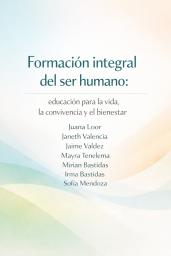
Formación integral del ser humano: educación para la vida, la convivencia y el bienestar
Sinopsis
La formación integral constituye uno de los principios rectores de los sistemas educativos contemporáneos. En Ecuador, la Constitución de la República (2008), la Ley Orgánica de Educación Intercultural (2011) y el Currículo Nacional (2016) reconocen explícitamente la educación como un derecho fundamental orientado al desarrollo pleno del ser humano en sus dimensiones cognitiva, afectiva, social, corporal, ética y espiritual. El presente libro analiza el proceso de formación integral en todos los niveles del sistema educativo ecuatoriano no universitario: educación inicial, preparatoria, educación general básica y bachillerato general unificado. A partir de una revisión teórica y normativa rigurosa, se articulan los aportes de la pedagogía crítica, el enfoque del Buen Vivir, la educación socioemocional y la interculturalidad como ejes transversales del desarrollo humano pleno. El texto propone una comprensión de la educación no como transmisión de contenidos, sino como práctica transformadora orientada a la vida, la convivencia democrática y el bienestar individual y colectivo. Dirigido a docentes, directivos, investigadores y tomadores de decisiones del sistema educativo ecuatoriano, el libro integra evidencia empírica internacional con experiencias pedagógicas situadas en el contexto latinoamericano y ecuatoriano.
Descargas
Referencias
Acosta, A. (2012). Buen Vivir, Sumak Kawsay: Una oportunidad para imaginar otros mundos. Abya-Yala/FLACSO.
Ainscow, M., Booth, T., & Dyson, A. (2006). Improving schools, developing inclusion. Routledge.
Ainsworth, M. D. S., Blehar, M. C., Waters, E., & Wall, S. (1978). Patterns of attachment: A psychological study of the strange situation. Lawrence Erlbaum Associates.
Asamblea Nacional del Ecuador. (2011). Ley Orgánica de Educación Intercultural. Registro Oficial Suplemento 417.
Biesta, G. (2011). The ignorant citizen: Mouffe, Rancière, and the subject of democratic education. Studies in Philosophy and Education, 30(2), 141-153. https://doi.org/10.1007/s11217-011-9220-4
Boqué, M. C. (2005). Tiempo de mediación: Taller de formación de mediadores y mediadoras en el ámbito educativo. CEAC.
Bronfenbrenner, U. (1979). The ecology of human development: Experiments by nature and design. Harvard University Press.
CASEL. (2020). CASEL'S SEL framework: What are the core competence areas and where are they promoted? Collaborative for Academic, Social, and Emotional Learning.
Chaux, E. (2012). Educación, convivencia y agresión escolar. Taurus/Universidad de los Andes.
Constitución de la República del Ecuador. (2008). Registro Oficial 449.
Dahl, R. E. (2004). Adolescent brain development: A period of vulnerabilities and opportunities. Annals of the New York Academy of Sciences, 1021(1), 1-22. https://doi.org/10.1196/annals.1308.001
D'Angelo, O. (2004). Proyecto de vida como categoría básica de interpretación de la identidad individual y social. Revista Cubana de Psicología, 17(3), 270-275.
Delors, J. (Coord.). (1996). La educación encierra un tesoro: Informe a la UNESCO de la Comisión Internacional sobre la Educación para el Siglo XXI. UNESCO.
Diamond, A. (2013). Executive functions. Annual Review of Psychology, 64, 135-168. https://doi.org/10.1146/annurev-psych-113011-143750
Dockett, S., & Perry, B. (2007). Transitions to school: Perceptions, expectations, experiences. UNSW Press.
Dray, J., Bowman, J., Campbell, E., Freund, M., Wolfenden, L., Hodder, R. K., McElwaine, K., Tremain, D., Bartlem, K., Bailey, J., Small, T., Palazzi, K., Oldmeadow, C., & Wiggers, J. (2017). Systematic review of universal resilience-focused interventions targeting child and adolescent mental health in the school setting. Journal of the American Academy of Child and Adolescent Psychiatry, 56(10), 813-824. https://doi.org/10.1016/j.jaac.2017.07.001
Durlak, J. A., Weissberg, R. P., Dymnicki, A. B., Taylor, R. D., & Schellinger, K. B. (2011). The impact of enhancing students' social and emotional learning: A meta-analysis of school-based universal interventions. Child Development, 82(1), 405-432. https://doi.org/10.1111/j.1467-8624.2010.01564.x
Epstein, J. L. (2001). School, family, and community partnerships: Preparing educators and improving schools. Westview Press.
Erikson, E. H. (1968). Identity: Youth and crisis. W. W. Norton.
Floridi, L., Cowls, J., Beltrametti, M., Chatila, R., Chazerand, P., Dignum, V., Luetge, C., Madelin, R., Pagallo, U., Rossi, F., Schafer, B., Valcke, P., & Vayena, E. (2018). An ethical framework for a good AI society: Opportunities, risks, principles, and recommendations. Minds and Machines, 28(4), 689-707. https://doi.org/10.1007/s11023-018-9482-5
Fredrickson, B. L. (2001). The role of positive emotions in positive psychology: The broaden-and-build theory of positive emotions. American Psychologist, 56(3), 218-226. https://doi.org/10.1037/0003-066X.56.3.218
Freire, P. (1970). Pedagogía del oprimido. Siglo XXI Editores.
Freire, P., & Macedo, D. (1987). Literacy: Reading the word and the world. Bergin & Garvey.
Galtung, J. (1969). Violence, peace, and peace research. Journal of Peace Research, 6(3), 167-191. https://doi.org/10.1177/002234336900600301
Gardner, H. (1983). Frames of mind: The theory of multiple intelligences. Basic Books.
Gilligan, C. (1982). In a different voice: Psychological theory and women's development. Harvard University Press.
Giroux, H. A. (1988). Teachers as intellectuals: Toward a critical pedagogy of learning. Bergin & Garvey.
Grantham-McGregor, S., Cheung, Y. B., Cueto, S., Glewwe, P., Richter, L., & Strupp, B. (2007). Developmental potential in the first 5 years for children in developing countries. The Lancet, 369(9555), 60-70. https://doi.org/10.1016/S0140-6736(07)60032-4
Heckman, J. J. (2006). Skill formation and the economics of investing in disadvantaged children. Science, 312(5782), 1900-1902. https://doi.org/10.1126/science.1128898
Hirsh-Pasek, K., Golinkoff, R. M., Berk, L. E., & Singer, D. G. (2009). A mandate for playful learning in preschool: Presenting the evidence. Oxford University Press.
Kohlberg, L. (1984). The psychology of moral development: The nature and validity of moral stages. Harper & Row.
Kowalski, R. M., Giumetti, G. W., Schroeder, A. N., & Lattanner, M. R. (2014). Bullying in the digital age: A critical review and meta-analysis of cyberbullying research among youth. Psychological Bulletin, 140(4), 1073-1137. https://doi.org/10.1037/a0035618
Marcia, J. E. (1966). Development and validation of ego-identity status. Journal of Personality and Social Psychology, 3(5), 551-558. https://doi.org/10.1037/h0023281
Maslow, A. H. (1954). Motivation and personality. Harper & Row.
Ministerio de Educación del Ecuador. (2014). Currículo de educación inicial. Ministerio de Educación.
Ministerio de Educación del Ecuador. (2016). Currículo de los niveles de educación obligatoria. Ministerio de Educación.
Moreno, J. M., Ríos, P. C., & Cano, A. (2022). Impacto de la pandemia en el aprendizaje y el bienestar de los estudiantes latinoamericanos: Evidencias y lecciones. Revista Iberoamericana de Educación, 88(1), 13-34. https://doi.org/10.35362/rie8814960
Moya, M., Glick, P., Expósito, F., De Lemus, S., & Hart, J. (2006). It's for your own good: Benevolent sexism and women's reactions to protectively justified restrictions. Personality and Social Psychology Bulletin, 33(10), 1421-1434. https://doi.org/10.1177/0146167207304790
Neck, H. M., Greene, P. G., & Brush, C. G. (Eds.). (2014). Teaching entrepreneurship: A practice-based approach. Edward Elgar.
Nussbaum, M. C. (2010). Not for profit: Why democracy needs the humanities. Princeton University Press.
OCDE. (2021). Beyond academic learning: First results from the survey of social and emotional skills. OECD Publishing. https://doi.org/10.1787/92a11084-en
Olweus, D. (1993). Bullying at school: What we know and what we can do. Blackwell.
ONU. (2006). Convención sobre los Derechos de las Personas con Discapacidad. Naciones Unidas.
Orr, D. W. (1992). Ecological literacy: Education and the transition to a postmodern world. SUNY Press.
Ortega Ruiz, R. (Ed.). (2010). Agresividad injustificada, bullying y violencia escolar. Alianza Editorial.
Paul, R., & Elder, L. (2003). La mini-guía para el pensamiento crítico: Conceptos y herramientas. Foundation for Critical Thinking.
Piaget, J. (1952). The origins of intelligence in children. International Universities Press.
Ribble, M. (2011). Digital citizenship in schools: Nine elements all students should know (2nd ed.). International Society for Technology in Education.
Rogers, C. R. (1969). Freedom to learn: A view of what education might become. Charles E. Merrill.
Rogoff, B. (2003). The cultural nature of human development. Oxford University Press.
Ryff, C. D. (1989). Happiness is everything, or is it? Explorations on the meaning of psychological well-being. Journal of Personality and Social Psychology, 57(6), 1069-1081. https://doi.org/10.1037/0022-3514.57.6.1069
Savickas, M. L., Nota, L., Rossier, J., Dauwalder, J. P., Duarte, M. E., Guichard, J., Soresi, S., Van Esbroeck, R., & Van Vianen, A. E. M. (2009). Life designing: A paradigm for career construction in the 21st century. Journal of Vocational Behavior, 75(3), 239-250. https://doi.org/10.1016/j.jvb.2009.04.004
Seligman, M. E. P., Ernst, R. M., Gillham, J., Reivich, K., & Linkins, M. (2009). Positive education: Positive psychology and classroom interventions. Oxford Review of Education, 35(3), 293-311. https://doi.org/10.1080/03054980902934072
Shonkoff, J. P., & Phillips, D. A. (Eds.). (2000). From neurons to neighborhoods: The science of early childhood development. National Academy Press.
Steinberg, L. (2008). A social neuroscience perspective on adolescent risk-taking. Developmental Review, 28(1), 78-106. https://doi.org/10.1016/j.dr.2007.08.002
Torney-Purta, J. (2002). The school's role in developing civic engagement: A study of adolescents in twenty-eight countries. Applied Developmental Science, 6(4), 203-212. https://doi.org/10.1207/S1532480XADS0604_7
Trapnell, L., & Zavala, V. (2013). Dilemas educativos ante la diversidad: Siglo XX en los países andinos. Derrama Magisterial.
UNESCO. (1994). Declaración de Salamanca y Marco de Acción para las Necesidades Educativas Especiales. UNESCO.
UNESCO. (1999). Declaración y Programa de Acción sobre una Cultura de Paz. UNESCO.
UNESCO. (2015). Rethinking education: Towards a global common good? UNESCO.
UNICEF. (1989). Convención sobre los Derechos del Niño. UNICEF.
Vuorikari, R., Kluzer, S., & Punie, Y. (2022). DigComp 2.2: The digital competence framework for citizens. Publications Office of the European Union. https://doi.org/10.2760/115376
Vygotsky, L. S. (1978). Mind in society: The development of higher psychological processes. Harvard University Press.
Walsh, C. (2009). Interculturalidad, estado, sociedad: Luchas (de)coloniales de nuestra época. Universidad Andina Simón Bolívar/Abya-Yala.
Westheimer, J., & Kahne, J. (2004). What kind of citizen? The politics of educating for democracy. American Educational Research Journal, 41(2), 237-269. https://doi.org/10.3102/00028312041002237
Zaitegi, N. (2010). La educación en y para la convivencia positiva en España. Revista Iberoamericana sobre Calidad, Eficacia y Cambio en Educación, 8(2), 93-132.
Descargas
Publicado
Colección
Licencia

Esta obra está bajo una licencia internacional Creative Commons Atribución 4.0.
Publicación bajo Licencia Creative Commons Atribución 4.0 Internacional (CC BY 4.0)